
Alternative Data Weekly #250
Theme: AI is a confident guesser; Alternative Data to the rescue

Special thanks to our sponsor:

Contact Michiel Maaskant to learn more.
QUOTES
“The data being fed to the AI tool needs to be as complete and recent as possible, so that the AI tool stack is well informed and knowledgeable about your company and your market.” - Omri Shtayer
News
Pods
Charts
Final Thoughts (Trust will be AI’s killer app)

#1 – Martech Edge published Omri Shtayer on AI Agents and Data-Driven Growth. August 2025.
My Take: The data feeding into the AI agent will make your agent a useful tool. There is a TON of noise in the market for agents right now. Customers are sifting through what is real & what is not. Drive value. Drive adoption.
Adoption is everything (See JaserBK article below). Good data helps drive adoption. Similar sentiment found in this Nitesh Bansal article, AI and machine learning projects will fail without good data. July 2025.
#2 – Facteus and Carbon Arc Partner to Democratize Consumer Transaction Data with On-Demand, Consumption-Based Model. July 2025.
“…This isn’t just faster access, it’s how we transform data from a locked asset into a liquid utility for the AI economy.”
My Take: This is a big deal when it comes to democratizing access to data. Consumer transaction data is “table stakes” for serious investors, but it was only available to the biggest firms given the cost of both the data itself & the cost of processing the data for insights.
This is a big change & should be good for the data industry.
#3 –Benn Stancil published Can analysis ever be automated?. August 2025.
My Take: Relating this article to this cool video from Anthropic: Claude for Financial Services Keynote. At minute 22:00, the AI does the entire analysis for the jr banker/analyst. They then have the information pulled into the standard format, and then the analysis is delivered to the PM with a buy/sell recommendation.
Do you trust that? As a junior analyst, are you willing to flip that document over to your PM. If you screw up once, you are out.
To be clear, tools like this are hugely positive, but the role of analyst is going to change. I’ve gotta believe you are going to want experienced human eyes on this whole process (way before it gets to the PM).
Historically, young people would learn and demonstrate skills (technical expertise, commitment to the team, diligence, thoughtfulness) as they went through the sometimes painful effort of compiling & organizing all the information. As a junior analyst, how do you “learn the job” when this type of grunt work is done for you?
“The price of intelligence is going to zero.” - Tharsis Souza, former Senior VP of Product Management at Two Sigma (Source)
BONUS: Auren Hoffman’s Data is actually not a great VC-backed business. July 2025. “trigger warning: there is a lot of pouring cold water on data businesses”
What else I am reading:
The Terminalist published Sink or Schwim- An LSEG Saga. August 2025.
JaserBK published #52 - One KPI to Rule Them All - Part 2/3. July 2025.
Barbara Matthews published LLM Training Data: Meet Poli August 2025.
Jorge Alvarez published B2B Blogging is Back: Why Content Marketing Still Matters in the Age of AI Chatbots. July 2025.
Seattle Data Guy published Anyone Else Struggling to Keep Up With Data Tools. July 2025.
Vin Vashishta published How Salesforce Uses Data Cloud To Solve Its Customers’ AI Last Mile Problem. August 2025.
Dilpreet Kaur published From Chaos to Clarity: Making SEC Filings LLM-Ready. July 2025.
Casewatcher published Pinsky Folds: What Yipit’s Stipulated Judgment Means for M Science—and Jefferies. June 2025. (h/t Jordan Hauer)
Jason Derise published A Bayesian Approach to Data-Driven Insights. July 2025.
JPMorgan says fintech middlemen like Plaid are 'massively taxing' its systems with unnecessary pings. July 2025.
WSJ: Amazon to Pay New York Times at Least $20 Million a Year in AI Deal
CIO Review published Sequentum: Tackling the Complex World of WebData Extraction at Scale. July 2025.

Source: The Media Copilot published How ScalePost’s Ahmed Malik is building an AI survival strategy for media. May 2025.
Ahmed Malik is the CEO of ScalePost.
My Take: This is a good discussion about the intersection of AI and media. There is a massive change happening in real time. Scalepost is like a mediator between content companies and AI companies.
Start with understanding the needs in the AI companies and going from there.
Scalepost’s differentiation:
Huge market; room for multiple players.
Content owners have data that is uniquely valuable for different use cases … understanding those use cases is key.
Helping content owners organize data for AI companies. How do content owners maximize value from AI?
Rights for AI companies and other companies … verticals keep expanding.
I thought this was particularly cool:
Content owners do not know how their content is being surfaced? This is quite opaque now. Scalepost can provide analytics to content owners.
What happens when an AI chatbot like ChatGPT or Perplexity writes a summary based on a topic instead of directing a person to a website?
This is a new world. CPM is no longer available. Surfacing or impressions?
Early days on how to value the content owner’s content, but it has to be done & will be done in time, as more data comes in.
Highlights (54-minute run time)
Minute 03:00 – intro.
Minute 06:00 – how Scalepost came into being.
Minute 08:00 – unlocking the scale; remove friction from the whole chain.
Minute 11:30 – how do you differentiate?
Minute 16:00 – unique relationship with Perplexity.
Minute 20:00 – metrics Scalepost can provide to content owners.
Minute 23:00 – AI substitution risk.
Minute 27:00 – copyright litigation; discussion.
Minute 31:00 – from a mkt perspective, value of training data coming down.
Minute 35:00 – training on more specialized data.
Minute 38:00 – impact on evergreen content.
Minute 40:00 – vision for Scalepost.
Minute 45:00 – protection from “bad actors”.
Minute 49:00 – changes in publishing; moving from fear to opportunity.

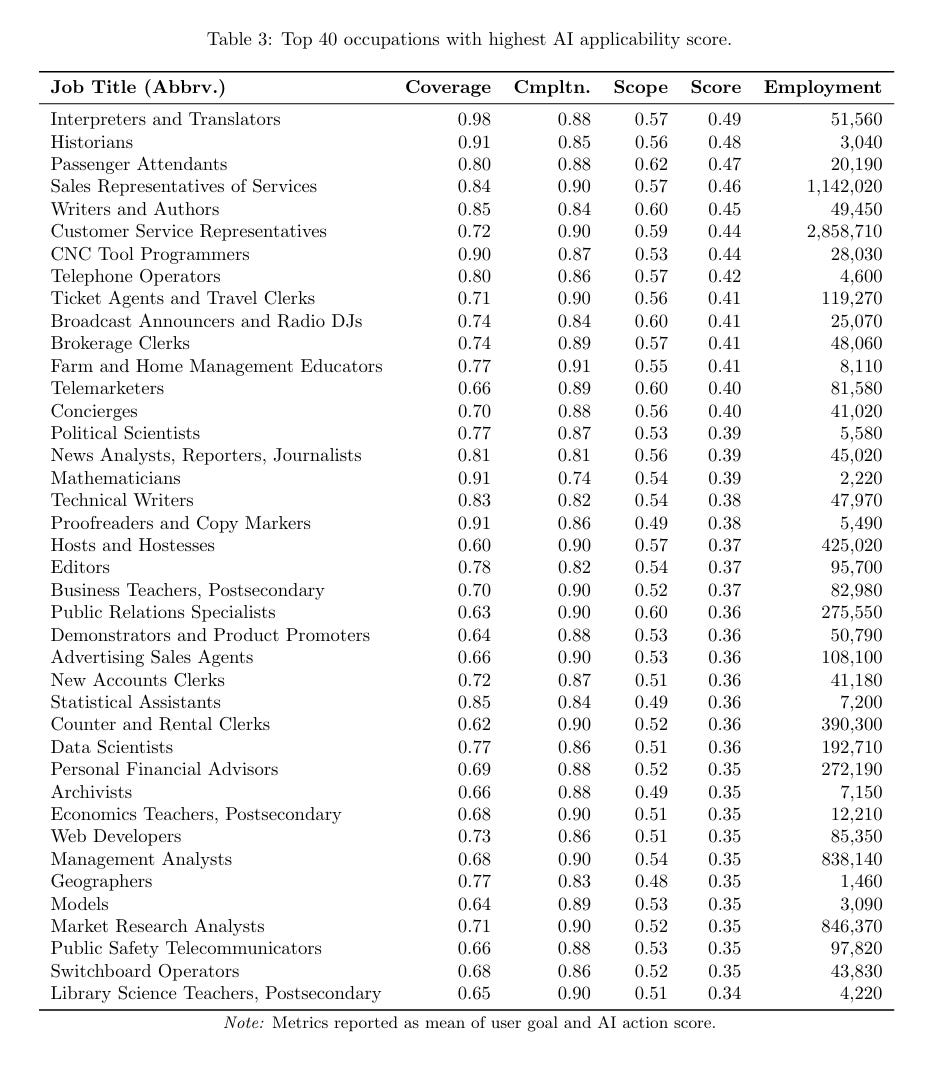
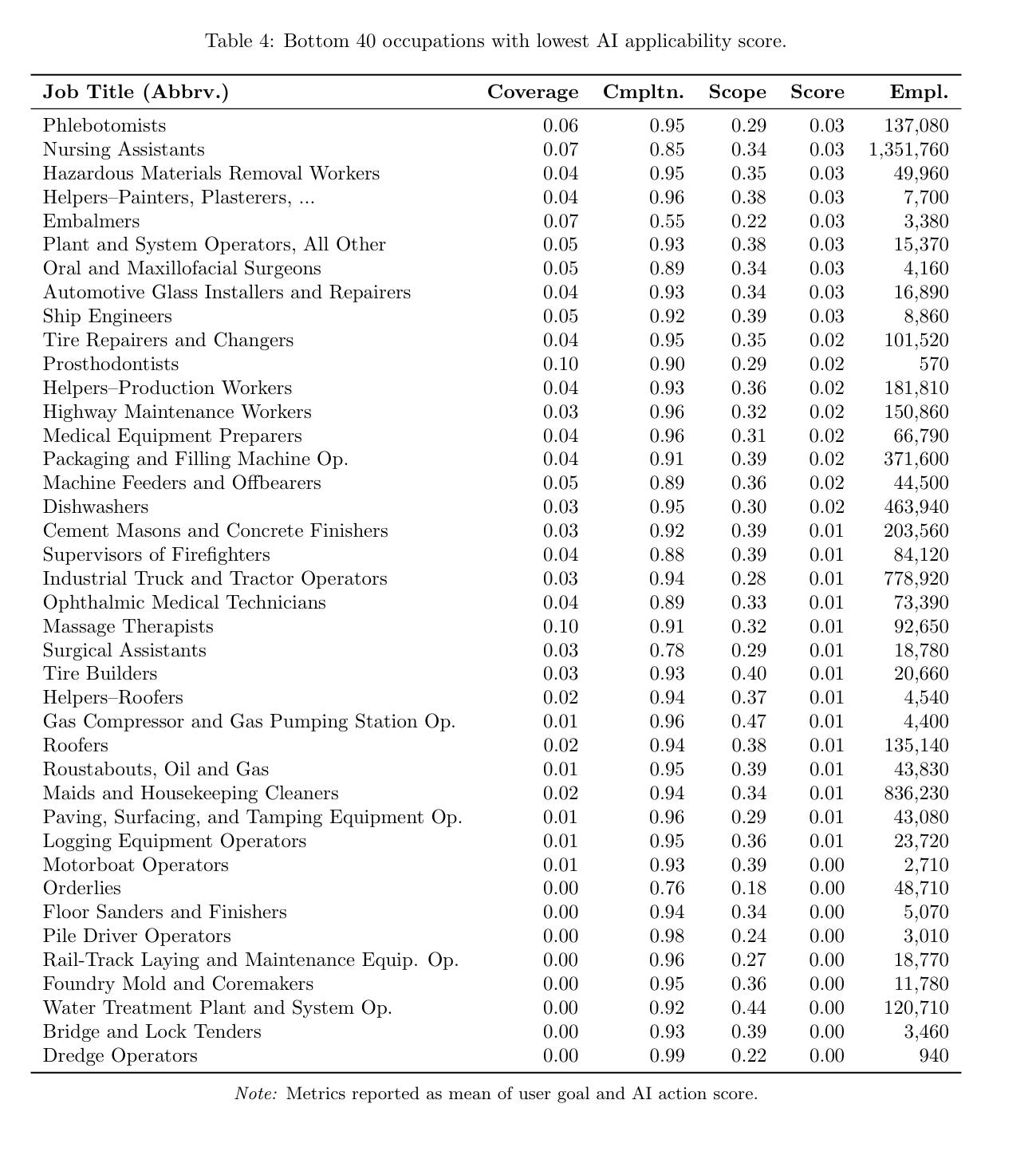
Source: A series of Microsoft researchers published Working with AI: Measuring the Occupational Implications of Generative AI∗. July 2025.
“We analyze a dataset of 200k anonymized and privacy-scrubbed conversations between users and Microsoft Bing Copilot, a publicly available generative AI system. We find the most common work activities people seek AI assistance for involve gathering information and writing, while the most common activities that AI itself is performing are providing information and assistance, writing, teaching, and advising. Combining these activity classifications with measurements of task success and scope of impact, we compute an AI applicability score for each occupation. We find the highest AI applicability scores for knowledge work occupation groups such as computer and mathematical, and office and administrative support, as well as occupations such as sales whose work activities involve providing and communicating information.”
This is a list of jobs most at risk of being disrupted by AI.
This is a list of jobs least at risk of being disrupted by AI.

Trust will be AI’s killer app
Trust is the key. See thoughts above on the role of the analyst.
Check out this video: Claude for Financial Services Keynote.
This is incredible. These tools are going to change the job of the junior analyst.
The big question: as a junior analyst pitching ideas to your PM … do you trust this?
If you send your PM a note recommending to buy/sell the stock, and your numbers are wrong, not because of earnest effort, but because you left the grunt work to the model.
What happens?
How do you check?
What is your ground source of truth?
And if your answer is that the model is never wrong, great…then what is your job?
Perhaps Alternative Data can help provide the trust.
AI Invest August 2025. The Fracturing of Trust: How Political Interference Undermines Economic Data and Market Stability
“This has led to a shift toward alternative data sources, such as satellite imagery for agricultural output or real-time payment analytics, to cross-verify official reports.”
Disruption = Opportunity.