
Alternative Data Weekly #263
Theme: turning data/AI experiments into paying customers & future jobs

Special thanks to our sponsor EventVestor.

QUOTES
“The old adage ‘garbage in, garbage out’ takes on new dimensions with agentic AI. These systems don’t just process bad data — they reason with it, build upon it, and use it to train future iterations. – Matt Johnson
News
Pods
Charts
Final Thoughts (Scient Experiments —> Real Businesses)

#1 – Sebastian Hewing, the DataActionMentor, published Rethinking the Single Source of Truth. October 2025.
My Take: I assumed identifying a “SSOT*” was easy. It is not. Even common terms like revenue can get confusing. The goal is to have a solid “structure” without being “singular”.
“…alignment isn’t about forcing everyone to see things the same way. It’s about making sure everyone understands why they see things differently and agreeing on the language to describe it.”
* Single Source Of Truth.
#2 – Timo Dechau published Pragmatic Orthodoxy - Data Signals #1 - 03.11.25. November 2025.
My Take: I like this article because it talks about simplicity. Simple is elegant. Optimize for human time, not cheap storage.
Understanding your workflow becomes essential. Start small, don’t try to model your entire organization, map the workflows of small tasks, and see how they all eventually fit together. Get stuff done.
Start with the simplest thing that works. Avoid creating academically impressive science projects that don’t deliver value.
“…start simple, add complexity only when reality demands it”.
#3 – Michael Spencer published AI and the Future of (Non-existent) Work. October 2025.
My Take: As the dad of college-aged kids, I am seeing the concern about the future of the workforce. I advise that it will be different, and there will be disruption in certain types of work. Choose wisely.
That said, I am a believer that there won’t be enough humans to do all the work created by AI. This is contrary to the author’s opinion that AI is changing work rather than creating new, valuable jobs (“ROI for civilization”) or disrupting the old, boring jobs (real automation).
Related article from Jing Hu of 2nd Order Thinkers.
Titles and roles will change. But as AI changes roles, the important skills will be domain experience & asking good questions. Today, simply knowing how to use a tool (MS Excel, Bloomberg, PPT, etc.) better than anyone is a core skill of a “white collar good job”.
Good questions and applying your human experience requires more creativity and intellectually stimulating engagement than being able to navigate MS Excel without a mouse.
“Overall, our metrics indicate that the broader labor market has not experienced a discernible disruption since ChatGPT’s release 33 months ago, undercutting fears that AI automation is currently eroding the demand for cognitive labor across the economy.” - Evaluating the Impact of AI on the Labor Market: Current State of Affairs
BONUS:
What else I am reading:
Alex Izydorczyk published How to do Alt Data Research. November 2025.
Dan Entrup published The 2025 Data, Research & Information Services Landscape. November 2025.
Mindful Data by Cindy published Reflections from the San Francisco Data Summit. October 2025.
Finextra published Anthropic beefs up Claude for Financial Services. October 2025. (Anthropic’s post).
Wharton published Accountable Acceleration: Gen AI Fast-Tracks Into the Enterprise. October 2025.
Rebecca Natale of Waters Technology published SIX, ViaNexus build market data platform to unite data consumers, producers. October 2025.
Nomad Data published The Future of Investor Reporting: How AI Is Reshaping Fund Reporting & Investor Communications. October 2025.
Colin Reak published AI in Enterprise Workflows. November 2025.
Andre Retterath published AI is Killing Consulting - Slowly, Then Suddenly. October 2025.

Source: Tobias Macy of the Data Engineering Podcast interviews Omri Lifshitz (CTO) and Ido Bronstein (CEO) of Upriver. Bridging the AI–Data Gap: Collect, Curate, Serve - E487. November 2025.
My Take: I was concerned this was going to be “too technical” when I first came across this podcast. I found it fascinating, and the team from Upriver does a good job of talking about the business-level problems they are solving.
There is no magic here. You still need to do the work to make these models and AI systems work. And, as I have seen over and over in the data world, the devil is in the details.
There is a growing gap between AI’s demand for high-quality data and organizations’ current data practices.
How do you move from POC Phase à Production Phase…said differently, moving from an interesting science experiment to actual business value.
Three different pieces to get right to effectively use models & agents:
Collect the right data.
Curate the data (context).
Serve to models (workflow).
One idea that struck me was that AI allows you to take advantage of a MUCH broader set of data assets. This opens up massive opportunities that we are not even thinking about today.
We need to think about how we add AI to the set of consumers of the various platforms:
Data systems are built for humans to consume.
Data systems are not built for AI to consume.
Other notes:
Cost issues if you let agents run rampant.
Problem: how to connect hundreds (thousands?) of data assets and the context of the business. This is hard with structured data…very hard for unstructured data.
Evals … trying to get agents to check agents for accuracy … human in the loop? How to evaluate the output of an AI system?
Need to give agents the right data (this is hard) and the right context (this is even harder).
Q: From your perspective, what is the biggest gap in the tooling or technology for data management today?
A: Ability to stitch the pieces together.
Goldilox amount of data:
Curate the context for the task you want to do.
How to deliver the right context at the right time?
“Data Context Layer” that turns “tribal knowledge” into a “machine-usable mode.”
Implementation specifics as you move from batch to streaming.
Big challenge … people want to use AI, but they are not actually clear on what they want to achieve.
Highlights (50-minute run time)
Minute 02:00 – interview starts, intros.
Minute 04:00 – growing demands of AI systems.
Minute 08:00 – description of the problem.
Minute 10:00 – AI in production.
Minute 13:00 – making AI-ready data.
Minute 18:00 – rethinking how data assets are structured.
Minute 21:00 – goldilox amount of data to serve up to models/agents.
Minute 24:00 – incorporating third-party data sources.
Minute 26:30 – skills gap & changing org structures.
Minute 32:30 – core engineering challenges.
Minute 37:00 – biggest challenges they are seeing.
Minute 43:00 – what are the right use cases vs the wrong use cases?

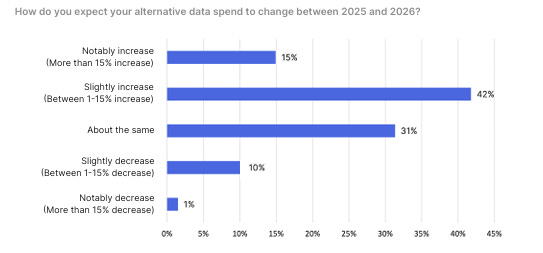
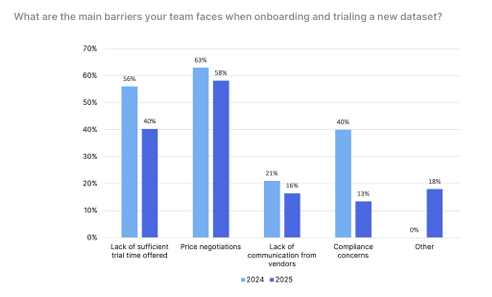
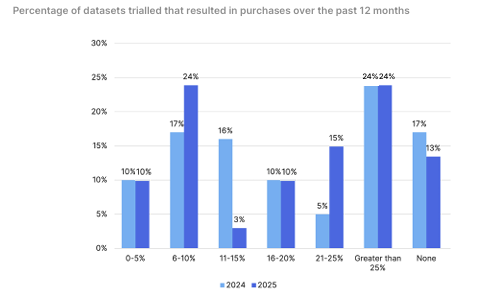
SOURCE: Neudata’s The Future of Alternative and Market Data 2025. October 2025.
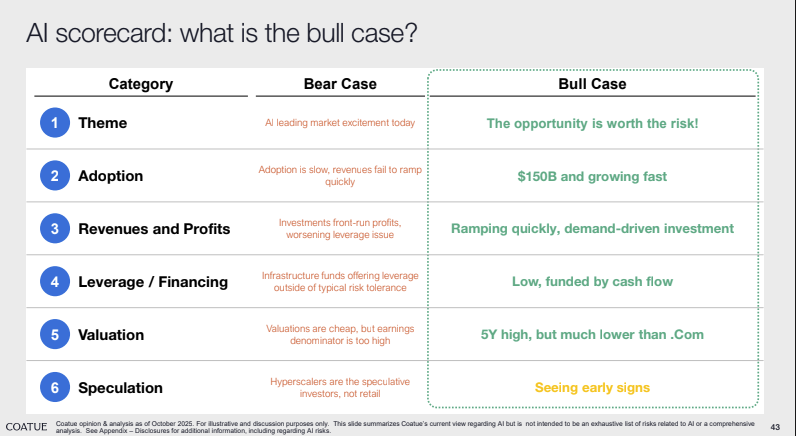
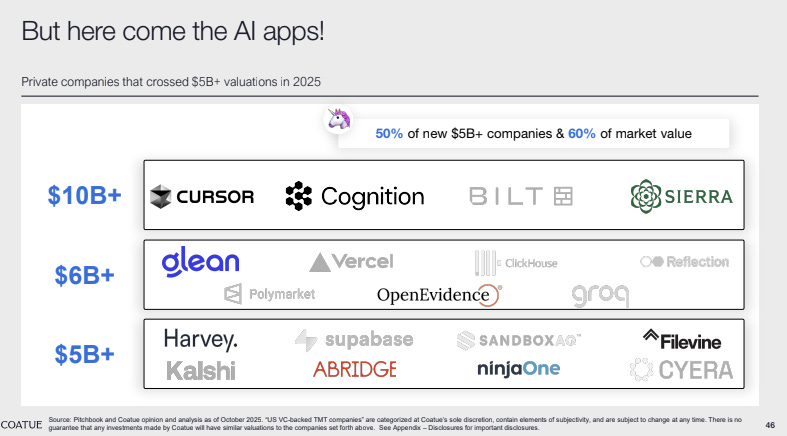
BONUS: Coatue’s Public Markets Update 10-2025
BONUS 2: AskRally GenPop™ Panel Launch. November 2025.


Q: What’s the difference between a cool science experiment and a real business?
A: Revenue.
As I continue to identify my next professional role, I have come across many cool & interesting technologies that are striving to become businesses. The key is figuring out which opportunities are just cool science experiments and which can become real businesses.
I am an optimist and am amazed at how the world is going to change. If only a few of these ideas take hold, there will be great companies created, generating an immense amount of value along the way.
One takeaway that is counter to common expectations is that AI will be a massive job creator (see above commentary). There will be disruption and some “good” jobs will change, but there will be a need for more humans to do interesting, intellectually stimulating work far into the future.
New Term of the Week:
Prompt Creep
When your “quick query” turns into a 1,000-word essay and you’re still adding “just one more parameter.”