
Alternative Data Weekly #278
Theme: From Data Moats to Workflow Moats

Special thanks to our sponsor Sequentum.

Sequentum Cloud powers scalable web automation, precision data extraction, and production-ready data pipelines: build AI-augmented agents, bypass blockers, customize workflows down to the atomic level, and capture the deterministic data your strategies demand. Start your FREE TRIAL of Sequentum Cloud today.
QUOTES
“The strongest moats come from access to proprietary data, deep integrations into the workflows, and teams that have strong domain expertise. Because at the end of the day, models and infrastructure will keep evolving, but the companies will have their own unique data loops, and hopefully they’ll be embedded in multiple workflows. Over time, all those efforts will compound, giving them the resilience to endure.” - Sunil Chhaya, Co-Founder and General Partner, Kearny Jackson
News
Pods
Charts
Final Thoughts (is this the week in which a decade happened?)

#1 –Brian Lichtenberger published Proprietary Data Is Not What You Think It Is. February 2026.
My Take: The author raises some excellent questions. If everyone has access to (basically) all the data, all the time … where does the value flow?
Even proprietary data is useless unless it is changed into a format that adds business value. That process adds a ton of value. Done well, it can generate real value. Done poorly, even with “proprietary data” and you can be left wanting.
I’d add, the question is going to be the moat. If you are asking the right question at the right time, you will generate a lot of value for your organization.
#2 – Steve Carroll published Are we right to be wary of financial data stocks? February 2026.
My Take: There has been A LOT written about the end of SaaS and financial data stocks in recent weeks. These have largely been bullet proof businesses for 20 years. People need what you are selling. These businesses locked customers into their interface and divided up the world into FactSet or Bloomberg … Salesforce or HubSpot. You had to pick one or the other. Each had positives and negatives. You just dealt with it.
It was (is) a big deal to move from a company that uses Salesforce to a company that uses HubSpot. I did this once and it took me months to figure out how to effectively engage with HubSpot after years of Salesforce. I was never as proficient. The promise of AI is that this will no longer be the case.
It will not be platform lock, it will be workflow lock. The data sitting in the background will be just that, in the background. As the user, I will just ask the right question at the right time for that day’s workflow. The system will just give me the right answer & share tips about my likely next best step.
My guess is those roles with less defined workflows (ex. enterprise sales, talent evaluation, people management) will be in high demand. Any job where you can write down literally everything you specifically do, and why you do it, will be at risk.
#3 – Didier Lopes published The context wars in financial services. February 2026.
My Take: Context is really valuable. Context is hard. I think the next step will be really breaking down the workflow of the highest performing people. Some roles can be very process-oriented with defined results. For investing, the outcome is defined (Did your trade work? Did you beat the market?), but the process of the best investors is still opaque. I’d love to see the minute-by-minute workflow of the highest performers in any field.
In the spirit of the Olympics, we see this with high performing athletes. They may share their daily training schedule and eating habits. But what about the really effective salesperson. What are they doing minute-to-minute during their day? This type of context and engagement would be fascinating, but is tough to model.
BONUS: Matt Robinson of AI Street published Five Minutes with Kirk McKeown, Co-Founder and CEO of Carbon Arc. February 2026. “We didn’t build this platform for eight billion people. We built it for 30 billion agents.”
What else I am reading:
Jody Hesch published The Real Reason Snowflake Acquired Observe (Part 1, Part 2, Part 3). February 2026.
Diana Todea published VictoriaMetrics at FOSDEM, Cloud Native Days France, and CfgMgmtCamp Ghent. February 2026.
Joe Reis published The Lilliputians Have AI Now: On SaaS and the Era of Disposable Software. February 2026.
Dan Entrup published Are You a Software Company or a Data Company? February 2026.
Nicolas Bustamente published The Crumbling Workflow Moat: Aggregation Theory’s Final Chapter. February 2026.
Derek Robertson and Matthew Kosinski published Observability trends 2026. January 2026.
Rob Thubron published IBM says it will triple entry-level hiring for roles “we’re being told AI can do”. February 2026.

Source: Christine Yen & Charity Majors shared The Next Era of Observability: Founders’ Reflections. February 2026.
My Take: excellent background from a couple people who have been in the observability space for a long time (i.e, before observability, & how it evolved).
They take a look back a founding Honeycomb.
What they got right:
right about problem
right about solution
What they got wrong:
wrong about how hard it was to bridge the problem & solution
Key question: What’s happening in my system? With exponentially more code being developed, it exponentially impacts this entire process and creates the need for fast feedback loops.
“…reading behavior is more important than reading code” – 21:45
I thought this was a good articulation of he problem (minute 42:00):
Cost of false positive = burns people
Cost of false negative = burns trust
HIGHLIGHTS (57-Minute Run Time):
Minute 02:00 – conversation starts
Minute 07:00 – Honeycomb inception (Observability Engineering book)
Minute 10:45 – thinking from first principles and the early days of Honeycomb
Minute 16:30 – carrots vs sticks
Minute 19:00 – “…it took me a while to realize that AI was the opportunity we were looking for all along”
Minute 27:00 – switch to Q&A
Minute 38:00 – key question: What’s happening in my system?
Minute 47:00 – alert fatigue
Minute 50:00 – exponentially more code being developed exponentially impacts this entire process (need fast feedback loops)
Minute 57:00 – Christine does not like dashboards (“Static dashboards should die.”)
BONUS: Philip Gervasi of telemetry Now Podcast talks with Uber’s Vishnu Acharya about Practical MLOps for Network Operations at Uber. January 2026.
“Modern network operations are operating at a scale and at a pace that just didn’t exist a decade ago.
As networks become more dynamic, more distributed, and more tightly coupled to business outcomes, those more traditional approaches to troubleshooting capacity planning and operations in general kinda start to break down.”
Related article:
Raghu Nandakumara published Threat hunters can’t waste time stumbling in the dark – they need real observability. January 2026.
“It requires understanding how systems relate, behave and change over time, and connecting those insights before an attacker does.”
“…shifting detection strategies toward behaviors and relationships”

SOURCE: Theo Vasilis published State of web scraping report 2026. February 2026.


SOURCE 2: Fulcrum Research published 1H 2026 Data Intelligence, Analytics, & Infrastructure Market Sizing & Five-Year Forecast Report. January 2026.
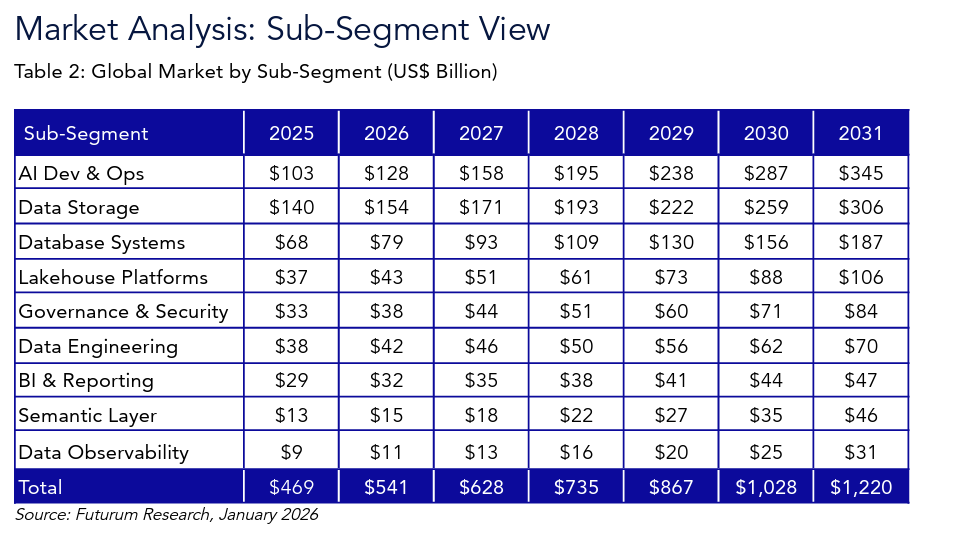

Source: Asymmetrix published Proprietary data ain’t what it used to be and picking winners in the Data & Analytics sector. February 2026.
This post was a great read &, among many other sources, is helping me think about this changing world. Where does value flow over the coming years. How do I make the best use of these new tools?
Last week, I went down the latest rabbit hole: are all SaaS companies dead? What does it mean to be a system of record and lock entire organizations into an effective, but less-than-ideal workflow?
What does it mean if everyone just brings their own workflow (will this be like BYOD?).
“There are decades where nothing happens; and there are weeks where decades happen.”
Another week has passed during which A LOT has happened. This seems to happen every week. New tools, new business models, new bot-operated social media platforms.
Here is my big picture take on AI.
Really good engineers, those people who are creative, customer-focused, while at the same time very process-oriented and work in very orderly manners (do this, then do that next …), are having their minds blown. These systems are far more than RPA on steroids (Robotic Process Automation). AI takes the ability to create to the next level. The systems can ingest many options for the next steps and make decisions based on limitless inputs. People with this type of engineering-mind are winning because of these tools. Our engineers at SymetryML are building cool things at hyper-speed. Our customers are benefiting.
Below-average engineers who just manage a process & do the next thing on the list (“I watch this dashboard and react when something changes”) … people in this type of role will be disrupted.
From a sales perspective, the “GTM stack” where you can much more effectively identify & connect with a targeted audience … this role is going to get disrupted. The high-performing people in this role have been given super-powers. But “high performing” used to be the people with high EQ who would grind, make more calls, send more emails, post more on social media. Now the high-performing meeting generators will be people who set the right process and manage those processes (“agents?”) most effectively. The biggest winners will be those who incorporate EQ in the process.
For enterprise sales (this is where I live) … I love the work of Jen Abel. This role is going to benefit from AI like many others, but what will remain the same is performing when you get the opportunity. Building personal trust with the buyer. Understanding the buying process. Helping your prospect get invested in the outcome & sell your product internally. The tools can help you be more efficient, but you still need human-to-human engagement & connection.
Oh, and having a great product that solves real problems helps too.
Translating this type of language is where AI will struggle :
enterprise translation
"i'd like to get this done ASAP" >>> within the month
"send me your paper" >>> i'll send you back mine
"this is f'in awesome" >>> there's a possibility
"let me circle back" >>> this is dead
"let's go" >>> onboard me tomorrow
In any case, I am happy at SymetryML to be selling really good tools to the gold miners (the great engineers) who are changing the world.
Just remember, disruption is a feature of our economic system, not a bug.
Thanks for the hopeful article about IBM tripling entry-level hiring. I’m curious what your career advice is to college students and recent grads?