
Alternative Data Weekly #280
Theme: AI will reward the firms that know their data & workflows, and expose the ones that don’t.
Special thanks to our sponsor Carbon Arc.

Carbon Arc's platform gives access to institutional-grade economic and transaction data. See the data assets at work in our latest report, an early signal for monthly SMB payrolls.
QUOTES
“The product of your data team is easy and speedy access to trustworthy, understandable information that helps the company make more money and helps your stakeholders and you live better lives.” - Sebastian Hewing
News
Pods
Charts
Final Thoughts (how I am working with AI)
LMK if you’ll be at either of these NYC events:
March 10 – Grafana’s ObservabilityCON
March 12 – Honeycomb’s O11Y_Day

#1 – Alexey Grigorev & Valeriia Kuka published What 1,000+ Job Descriptions Reveal About the AI Engineer Role in 2026. March 2026.
My Take: Seeking: someone, possibly called an AI engineer, who can take this existing human-intensive, possibly mind-numbing, workflow and make it so that it is transparently & reliably done by AI. Make the benefits immediately obvious to all. Go.
#2 – Zain Hoda published The Agent Will Eat Your System of Record. February 2026.
My Take: The system of record vs. AI has been a hot topic. I thought this X post was a good articulation of the issue. Being the system of record is (was?) the most defensible position in enterprise software.
When your AI agent is your primary interface, it doesn’t matter where the data is stored.
Does the role of governance help the systems-of-record players stay relevant? Is it some sort of workflow optimization? Is it a massive consolidation between CRM, finance, and HR systems so all the important data lives in one place with an optimized AI workflow on top? Doubtful.
It will be fun to watch this play out over the next few years (and I do believe it will be many years … big companies just don’t move that quickly).
#3 – Tomasz Tungus published Not Prompts, Blueprints. March 2026.
My Take: BYOW (Bring Your Own workflow) will be powerful in the coming years. This is the “blueprint” of how I, as a highly effective person, work day-to-day. What do the most productive/effective/best employees do that is different than the less effective employees? I recall earlier in my career as a sell-side salesperson, seeing how the more experienced guys did their work. They made more money than me and seemed to have it all figured out. But what they actually did day-to-day, hour-to-hour, was a mystery.
I jokingly asked my boss if they were sending magic emails (?), and that is why they made so much money. Whatever blueprint made them successful (success = drive more revenue for the company) should have been made available for training purposes. Even if their core skill was internal politicking … then that should be part of the blueprint. Once AI understands that framework, it can help everyone in those roles improve.
BONUS: Vin Vashishta published The Great Platform Reckoning: Will A System Of Record Save SaaS?. February 2026. “The paradigm most people are overlooking is that being a system of record was never actually a moat. It was a side effect of the real moats: switching costs, workflow embedding, UI-driven habit formation, and data format lock-in. The system of record status was the result of those dynamics, rather than their cause. AI agents are now systematically dismantling each of those underlying moats.”
What else I am reading:
Matt Ober published Alternative isn’t Alternative. March 2026.
Dan Entrup published We’re Building The Uber For Bloomberg. March 2026.
Daniel Beach published Will AI kill (Data) Engineering (Software)? February 2026.
Joe Reis published Beyond Rows and Columns: The Five Forms of Data. February 2026.
Jody Hesch published The Real Reason Snowflake Acquired Observe (Part 1, Part 2, Part 3). February 2026.
Andy Mann published Why Your Observability Platform Has Become A Bottleneck. February 2026.
Strawberry Data published Top 10 Most Explicit Podcast Episodes by Profanity Rate. February 2026.
Martin Mao published Observability in transition: Building confidence on the path to agentic workflows. November 2025.

Source: DQE’s Let’s Talk Data podcast published Ep2 | Data quality: How AI can turn data quality from a challenge into a competitive advantage, February 2026.
In Episode 2, Philippe Boulanger and Dylan Anderson explore why AI has become the most powerful companion to data, and why it raises the stakes on data quality like never before. Where business intelligence and analytics once required specialist skills, long lead times, and retrospective insights, AI now puts answers directly into the hands of business users.
My Take: When I have talked to firms about commercializing their data, I’ve said the process they need to go through to prepare their data is valuable, whether they commercialize the data or not. The process of organizing and understanding what you have, where it is, and the level of quality, is a worthwhile project. This holds for AI. Launching new AI tools (that work) requires a foundational process that you need to go through to understand what you have & where your data falls short, so you can most effectively launch AI in your firm.
AI is a democratizer of data globally, but fixing data foundations is the key.
Lack of process will lead to data quality issues.
When thinking about how you get to the best output from the cool new AI tools … data quality comes first.
Need to see the value … or you lose momentum (14:00). Get early wins…focus first on building AI on top of the highest quality data in your firm.
Playbook:
Standardized essentials
Governance with teeth
Sequence use cases that put value in weeks, not years
Operationalize with a single source of truth
Focus on areas where AI can sharpen decisions
HIGHLIGHTS (18-Minute Run Time)
Minute 00:45 – interview starts.
Minute 02:00 – unstructured data; focused on your internal data.
Minute 04:00 – data quality issues.
Minute 08:00 – How does AI help with data quality?
Minute 12:00 – what needs to be prioritized?
BONUS: Angelo Calvello published The authenticity crisis — how AI-generated content is poisoning alternative data, ‘Institutional Edge’. February 2026.
In this episode of “The Institutional Edge,” Renee DiResta, associate research professor at Georgetown University and former technical research manager at the Stanford Internet Observatory, breaks down how AI-generated content and algorithmic manipulation are creating an authenticity crisis that threatens institutional investors relying on alternative data.

SOURCE: Daryl Smith of Neudata published The state of the alternative data market in 2026. February 2026.
“The alternative data market continues to grow at a strong pace. Neudata estimates investment managers spent approximately $2.8bn on alternative data in 2025, with spend up ~17% year-on-year.“


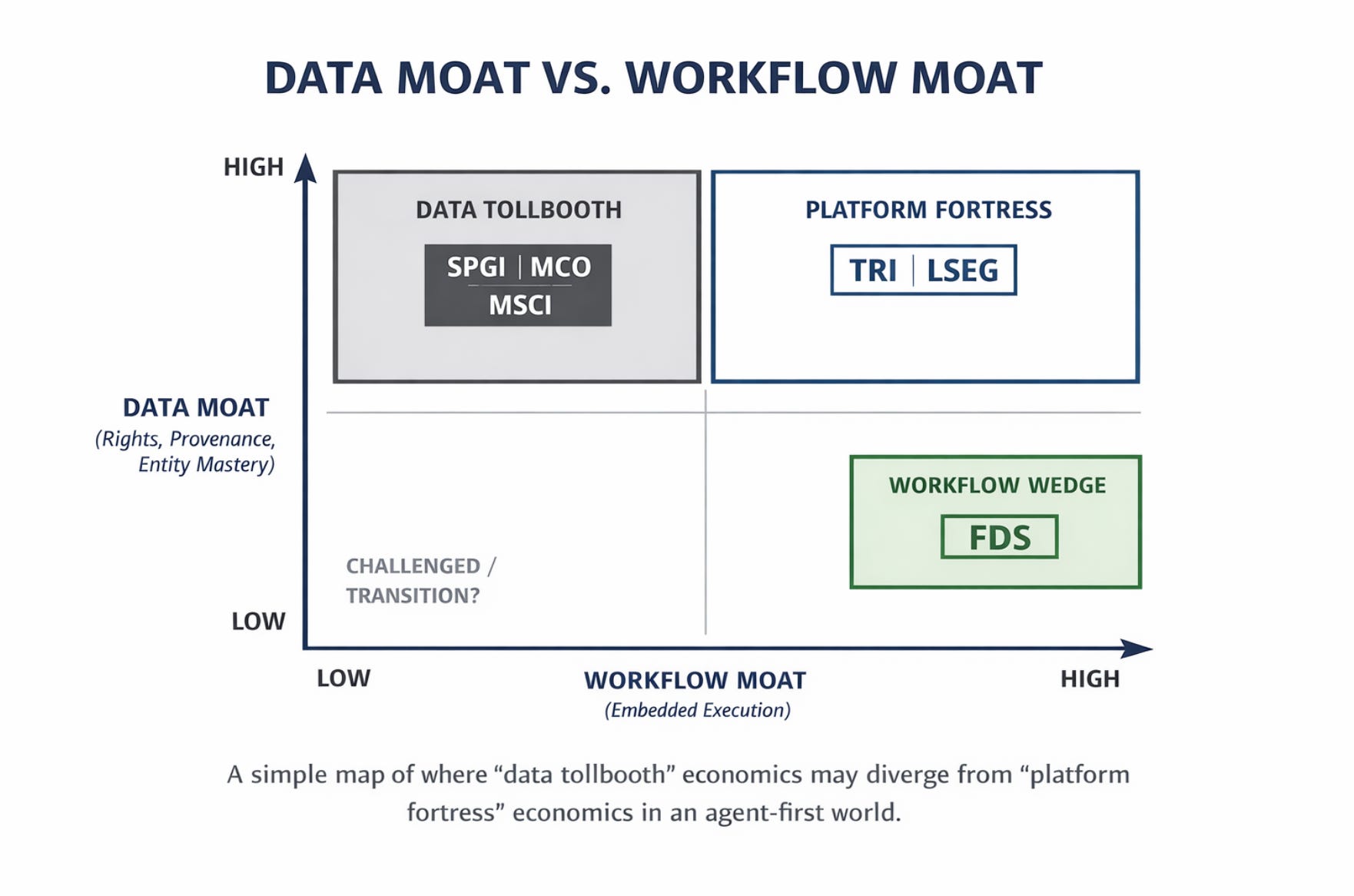
SOURCE 2: Jordan Hauer published Exploring AI’s Shockwave through Data Stocks’ Perceived Moats. February 2026.
The strongest takeaway is subtle: It’s not about whether investors are underestimating the data moat (although I think they are). But they’ve certainly underestimated how quickly monetization can shift when the UI changes.
This is why the best diligence now isn’t only “how unique is the data?” It’s: “Where does the agent live, and who gets paid when work gets done?”

How I am working with AI.
These are great tools. I pay for access to ChatGPT, Grok, and Claude. I use them every day.
Summarizing. Brainstorming. Helping craft messaging.
I’ve just started to automate some things (not really all that well yet). Going through this process has really helped me understand how I work.
Example:
I am cold-reaching out via email to a friendly intro for a new observability contact. I want to do this:
Review their LinkedIn for insight (common interests, where we might know common people, details on their role, etc.)
Review their company’s website for information, including blogs, case studies, etc where there is direct commentary relating to my company SymetryML, or something else, that might enhance our conversation.
See if they have other social presence (X, industry Slack channel, etc)
Review anything they have written in the past.
Incorporate anything from our internal CRM where someone else in my company may have met with someone in their company. Are there notes from that conversation?
I want a tool to do all this for me. This is what I am trying to get right. At the end of the day, it is my own personal blueprint/workflow sitting on top of all the relevant data. See the above articles that all go together.
Interestingly, this is largely the workflow my former company, ModuleQ, was implementing before our dissolution.
Going through this process of understsand how I work has been a valuable exercise.
This will be how people work in the future. best data. Best blueprints. Millions of unique workflows. Find the best ones and go.