Alternative Data Weekly #293
Theme: Cheap to Synthesize. Hard to Source.

Special thanks to our sponsor Brickroad!

Alpha isn’t found in a catalog. Brickroad’s information frontier agent finds alpha suppliers at the frontier - companies generating your target data who’ve never marketed it. Sign up for a 7-day Pro trial Here.
QUOTES
“AI commoditises the layer of research that requires synthesis, but it cannot replicate the layer that requires proprietary inputs.” - Asymmetrix
News
Pods
Charts
Final Thoughts (Teaching your AI)

#1 – Asymmetrix published The next wave of Data & Analytics M&A: research firms are buying their moats. June 2026.
My Take: Proprietary inputs become a key value layer. Proprietary inputs cannot be replicated and it gives you an edge. This value is amplified as AI commoditizes the organization and synthesis layer. If you have proprietary data, you are well positioned.
I really liked the idea that you still need an expert human to be the “authoritative voice that establishes their data as the industry’s reference point”.
Non-sponsored take: Asymmetrix does good work in the space and is a must follow for “stakeholders in the Data & Analytics industry”
#2 – Ben Lorica published Your Enterprise Data Deserves Better Than a Chatbot. June 2026.
My Take: As systems get bigger and more complex, you need to watch how multiple signals behave together to avoid painful disruptions. Watching single values against static thresholds is monitoring (“univariate”). Watching the behavior of entire systems is the needed next layer (“multivariate”). AI is amplifying this need.
Disclosure: this is in line with what my company SymetryML is doing.
#3 – Hugh O’Connor published What I Learned at Robotics Summit: The Physical AI Data Market Is Scaling Faster Than Most People Realize. May 2026.
My Take: the next hot job is data sourcing expert. Hugh shares with us his takeaways from the recently attended robotics summit. These physical AI tools need training data. He compares the maturity curve this market is experiencing to the maturity curve experienced in the early days of alternative data for hedge funds.
AI requires good data. This is becoming viscerally obvious to me as I get better at using these tools. Someone has to oversee that process.
BONUS: Larry Ellison (via Vivek Sen) on the need for proprietary data. “… for these models to reach their peak value, you need to train them not just on publicly available data, but you need to make privately owned data available to those models as well.” May 2026.
What else I am reading:
David Rotman of MIT Technology Review published A reality check on the AI jobs hysteria. May 2026.
Jordan Hauer published How We Work With Data Providers Today. May 2026.
Paul Bloom published Moneyball for book publishers and Substack writers. May 2026.
Dan Entrup published Futurum + ETR: The Future of Tech Sector Intelligence. May 2026.
A-Team Insights published Where is the Edge When Everyone Has the Same Alt Data? May 2026.
Charlie Simionescu-Marin published I’m pretty bullish on agentic commoditisation of code ripping up closed-source software moats. May 2026.

Source: Coatue Co-Founder Thomas Laffont, sat down with Boris Cherny creator and Head of Claude Code at Anthropic. May 2026.
My Take: Things are changing quickly in the AI space. It is interesting to hear from the front lines. It is good to know, when Boris was asked about his thoughts 3-5 years out, he responded that he thinks one month at a time as things are changing so quickly.
The singular focus at Anthropic: Enterprise coding. How to “productionize” it.
He joined Anthropic Labs on the prototyping team. I’d say they had some success. They created 4 things:
Claude code
MCP
Desktop app
Skills
These products all had immediate PMF internally
“Agentic coding” … the agent writes the code…you describe what you want. This is the future. I am seeing glimpses (see “final thoughts” below) and still feel like I have keys to a Ferrari but am using AI like it’s a Vespa.
HIGHLIGHTS (12-Minute Run Time)
Minute 01:30 – interview starts, background on Claude Code creation
Minute 04:00 – mission is to build safe AGI (model has to interact with the world)
Minute 04:45 – the work of a software engineer has changed
Minute 07:00 – how to manage agents?
Minute 09:00 – “Seeing a giant speed up in an engineer’s productivity, by hundreds of percentage points … yet we are still bottlenecked by engineers.”

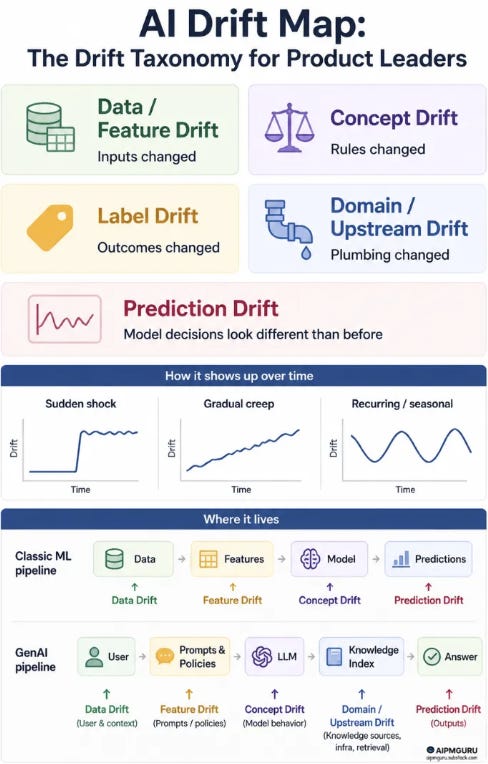
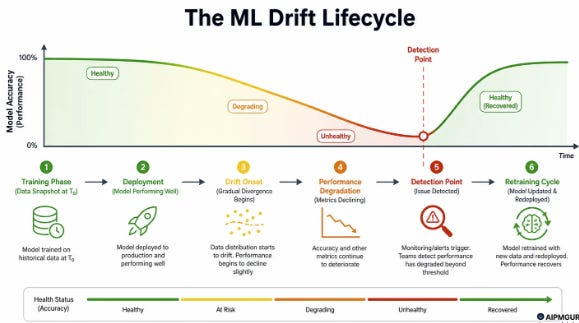
SOURCE: Shaili Guru published Drift on Foundation Models vs. Your Own Models. May 2026.
My Take: drift is hard to detect and expensive to observe. This caught my eye because detecting drift is what we do really well at SymetryML.

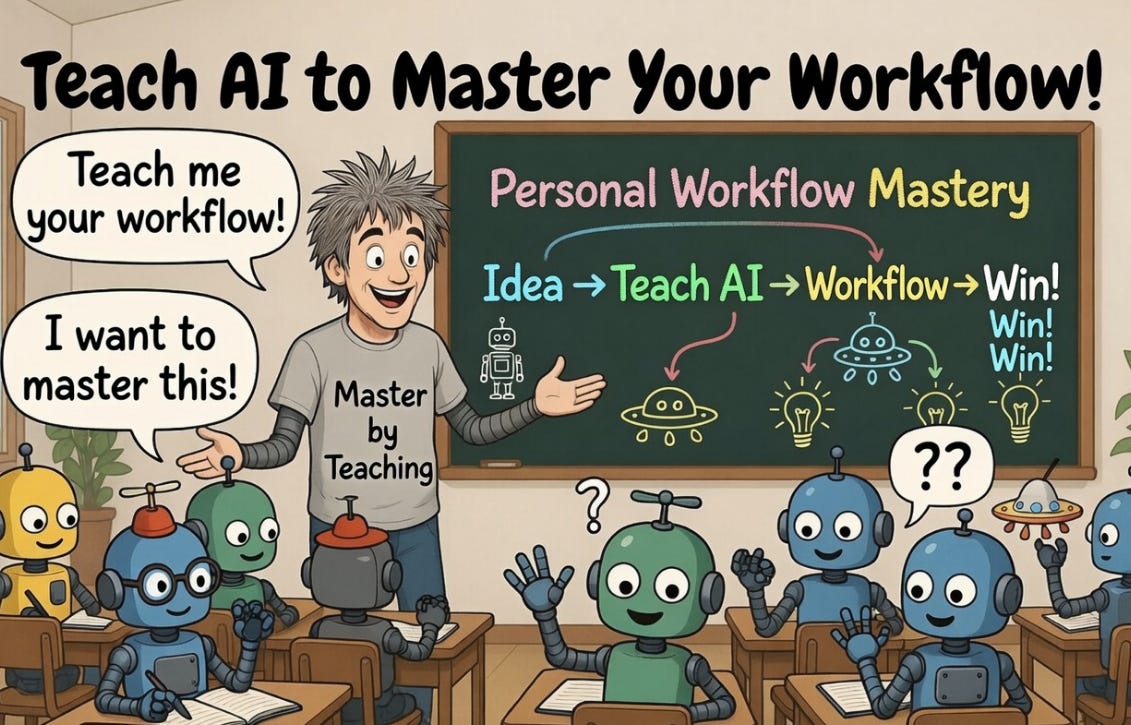
“If you want to learn something, read about it. If you want to understand something, write about it. If you want to master something, teach it.” Yogi Bhajan
I’ve read about AI agents the way you read about weight loss, it sounds great, it is motivating, but it never quite happens.
This spring that changed.
With a big assist from Rhys Fisher, I’ve been building what amounts to my own little operating system (Flow OS) on top of Claude Code. Not a chatbot. Something closer to a junior employee who never sleeps and slowly learns the way I do things.
Every time I do a piece of work: prep for a meeting, scan a competitor’s earnings, pull together a deal memo, the system writes down how I did it. It becomes like a playbook. The next time a similar task shows up, it reaches for that playbook instead of starting from scratch. The longer I use it, the more it sounds like me and the less I have to explain.
That’s the part that I’m finding really interesting. This system seems to compound. The knowledge lives in plain text files I can read and edit (and lives on my computer and private GitHub), it’s not inside some model I’ll never see. So, in theory, I am not locked into Claude, I could switch and keep the work and my “context”.
I’m not going to oversell it. Some days it’s magic. Some days it is off-base & frustrating. As I “teach” this system my job, it is becoming painfully obvious to me that I am not a process-oriented person. I am inconsistent and there is a lot of context-type-stuff in my brain that a computer might never be able to incorporate.
But the trajectory is real & upward, and for a mildly technical person running a couple different streams … 1-GTM at a startup, 2-ADW, 3-advising a couple of firms, 4-plus all the personal stuff that goes along with life … this has proven to be a valuable tool.
Lastly, like Thomas Laffont from Coatue, I am trying to wrap my head around what this looks like in 3-5 years and struggle (maybe the only similarity between me and Boris from Anthropic … see above podcast).