
Alternative Data Weekly #294
Theme: Delegation Without Verification (Danger or Opportunity)

Special thanks to our sponsor Brickroad!

Alpha isn’t found in a catalog. Brickroad’s information frontier agent finds alpha suppliers at the frontier - companies generating your target data who’ve never marketed it. Sign up for a 7-day Pro trial Here.
QUOTES
“Many companies struggle to harness clean, unified datasets (e.g., real-world data, physical surroundings, spatial data), which are essential to train the robots.” - Deloitte
News
Pods
Charts
Final Thoughts (@Alt_Data_Weekly)

#1 – Multiple authors from Deloitte published TMT Predictions 2026: The AI gap narrows but persists. June 2026.
My Take: There is a ton of good information here. From a data perspective, there is a consistent them that data governance, access, observability, etc is essential to making AI work well. Most companies have not gone through this, sometimes painful, process.
I have said in the past, if you own valuable data (and most companies do), even if you never externally commercialize the data, the organizational process you need to go through with your data is extremely valuable.
#3 – Inbar Rose published Why Truth and Trust Are No Longer the Same Thing. June 2026.
My Take: Interesting articulation of one of the bigger challenges in the age if AI. Trust takes years to build and can be lost in an instant.
“an outage may take hours to recover from, but a trust failure takes years.”
If your job is to make sure the “system is working”, your job has changed.
The consequences of low quality are bigger...if your search engine provides a bad result, you just press back-button. If an AI system attempted to resolve a billing dispute, and does so incorrectly, the customer is seriously pissed.
The author introduces the idea of a “reversibility budget” whereby you only take a human out of the loop when it is possible to reverse the action without too much consequence. Billing questions? … maybe a human should eyeball whatever the customer is getting as the “trust tax” on that correspondence is very high.
#3 – Asymmetrix published What MCPs mean for Data & Analytics Providers. June 2026.
My Take: I’ve heard of MCPs for some time and always felt like I kinda understood what they were. I’ve recently been using a few and incorporating them into my workflow. I am now more viscerally understanding what they are and why they are valuable. This summary from Asymmetrix was as good a description as I have come across.
“MCP eliminates the manual assembly of data from disparate sources into AI workflows”
My sense is, from the data provider prospective, there is a jevon’s paradox angle, meaning that the customer will consumer far more data when they can easily get that data into their AI workflows. How do you then capture that value? That is the challenge. My experience has been that I am not even aware what data is coming from which provider (and I really don’t care…I just want it to all work together & get my a trusted response). Consumption based pricing can result in opaque, erratic bills, … “workflow based pricing” sounds cool, but no one knows what that means. Fixed-fee leaves money on the table for the data vendor.
BONUS: Michael Horrigan, David S. Johnson, and Maggie Meinhardt published Restoring trust in economic statistics: Why it matters and how we fix it. May 2026. “On one hand, replacing data in surveys with declining response rates with higher quality and more reliable alternative data may improve trust. On the other hand, the mixing of various data sources to produce published estimates may produce a “black box” type of opaque understanding, even among technical users, that results in a feeling of a lack of transparency.”
What else I am reading:
Ergest Xheblati published How Data Creates Massive Leverage in Opaque Marketplaces. May 2026.
Eliot Raman Jones & Mya Jheeta published Will SEC reporting proposal supercharge alt data providers? June 2026.
Vin Vashishta published What Google Did To Websites Is Happening To Your App Right Now. June 2026.
Jasmine Sun published The independent writer’s advantage in the age of AI. June 2026.

Source: Brian Lamar & Andrew DeCilles of Signal & Noise podcast published an interview with Dan Entrup. The Research Industry’s Self-Inflicted Wound | Signal & Noise Ep 36. June 2026.
My Take: Bad data is a scourge in the age of AI. Dan’s company is a great example of the value created when you can produce/create high quality data.
Expert networks waste time reaching out to the wrong people as they work to find the right expert with whom to connect. Dan shares how “bad data” leads to negative results. Not just wasted time but, more importantly, a bad “customer” experience for the very experts (the respondents) you are trying to engage.
Two products:
Update & enrich (cleaning existing data)
Discover (recruiting new people)
Panelist retention is key metric. Another important ratio is outreach to successful connection.
Interesting discussion of AI moderators. The good & the bad.
Pro Tip: Sign up for your own panel. Eat your own dog food.
This is not a winner-take-all market, but there are A LOT of new companies being started in this space.
Side note: if you care about the data world, you should subscribe to Dan’s “It’s Pronounced Data” newsletter.
HIGHLIGHTS (54-Minute Run Time)
Minute 01:30 – interview starts; Aggknowledge background.
Minute 06:30 – the problem with the expert experience (Aggknowledge founding story).
Minute 13:00 – the current system invites fraud and bad data; Dan quantified his experience.
Minute 20:00 – client requests are not always rooted in reality; quality vs speed.
Minute 22:00 – how does Aggknowledge work?
Minute 27:00 – what does success look like?
Minute 31:00 – AI moderators.
Minute 35:00 – focus on the problem you are solving for prospective clients.
Minute 41:00 – what is happening in the market with regards to expert network related companies?
BONUS: Metrics & Mayhem podcast published Signal Drop: Position Before The Page. May 2026.
This is a podcast about the challenges of observability work. The best operational decision-makers get positioned before the moment. As it relates to my life, SymetryML focuses on putting SRE’s in a position where they can more thoughtfully react to alerts by sending them the alert earlier (“moved left”)and with more context.

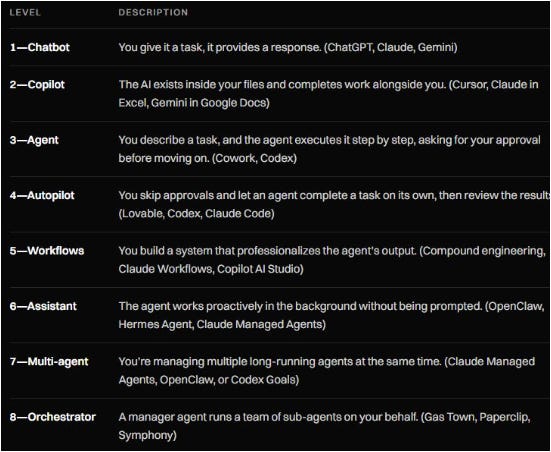
SOURCE: Every published The Eight Levels of AI Adoption. May 2026.
My Take: I tried Fable 5 and blew through all my credits in about 5 minutes. It was like using a flamethrower to light a candle.
On this scale created by Every, I am at level 4/5.

I set up a new X handle (@alt_data_weekly) and created an automated workflow where there is a automated post upon publication of this newsletter, and then one more post the following week.
Why?
To see if I could build it.
To see what kind of traction I can get on X.
Feedback welcome.
Thanks!