
Alternative Data Weekly #295
Theme: Someone's perfecting the fax machine right now

Special thanks to our sponsor Brickroad!

Alpha isn’t found in a catalog. Brickroad’s information frontier agent finds alpha suppliers at the frontier - companies generating your target data who’ve never marketed it. Sign up for a 7-day Pro trial Here.
QUOTES
“By giving this often rote, repetitive work to Claude, our data science team can focus on more strategic work like causal modeling, forecasting, and machine learning.” - Anthropic
News
Pods
Charts
Final Thoughts (Skeuomorphism)

#1 – Sonal Goyal published The Identity Crisis: Why Entity Resolution Is the Missing Foundation of Every Data Product Stack. June 2026.
My Take: this stuff is really hard, and this stuff is really important. Making sure you have high quality input data goes a long way to making sure you have trustworthy output. The author shares some best practices and advice for implementing this in practice (and yes, human-in-the-loop is still a requirement).
“The measure of a good implementation is not how little human involvement remains. It is whether the human involvement that does remain is concentrated where it actually changes outcomes.”
#2 – Patha Anbil published The AI Era: How Deep Learning is Overcoming Data Scarcity in Medical Imaging. June 2026
My Take: This caught my eye because SymetryML’s sister company Decentra Health plays in this space. Medical research is difficult, in part because of the need for privacy. Pulling together massive datasets that are robust enough for deep research is a challenge. Get the federated learning benefits without the associated risks. Every field where data is scarce or sensitive is making the same shift, from shipping the data to shipping the statistics.
#3 – Dan Poppy published DuckDB’s agent moment (Jordan Tigani). June 2026.
My Take: This is a transcript of a conversation between Tristan Handy and Jordan Tigani. This line caught my eye: “Data size and compute size are two different axes.”
The part I keep thinking about is how things change when the agents arrive (theme in recent weeks has been engaging with non-human data buyers/users). Agents don’t query like we do. A “swarm of agents branching, querying, and throwing away work hundreds of times a second,” running in the background, flagging the weird number before a human ever opens the dashboard. That’s a very different workflow. We are using new tools to accelerate old workflows, when workflows should be turned on their head (see Skeuomorphism in Final Thoughts).
BONUS: Dan Evans published Trust Doesn’t Come with the Dashboard. June 2026.“The gap between what your data says and what your people believe is often wider than leadership realizes, and it rarely closes on its own.”
What else I am reading:
Daria Cupareanu published How I Cut Prospect Research from 30 Minutes to 2 (Using AI). May 2026.
Abhimnav Agrawal published AI is Rewriting the Economics of Outsourcing. June 2026.
Alex Wilhelm published Observability overload is drowning engineers. June 2026
Interlatent published An Overview of Modern AI Robotics from First Principles. June 2026.
Elena Verna published The Mom-and-Pop SaaS era has arrived. June 2026.

Source: Rob Sarnie from “What the Heck Fintech” interviewed Evan Schnidman: How Evan Schnidman Went From Professor to AI Founder to Leading Fidelity Labs (Part 2). June 2026.
Part 1 – June 9, 2026 (link here) – 27 mins
Part 2 – June 16, 2026 (link here) – 26 mins
“Most interesting man in fintech”
My Take: great to get the current startup view from Evan’s perspective. He shares some background on himself (academic to entrepreneur … his comapny Prattle was first to use AI to analyze earnings calls… 2019 sold to Liquidnet).
He does talk about GTM. Startups are typically very good at product/engineering. Incumbents are good at GTM. Big companies already have the brand and the rails. I am seeing this ... there is SO much noise in the world right now, breaking through and getting the attention of the right people is key. Easier said than done. This is what I am good at, and what I like to do.
HIGHLIGHTS (Part 1: 27-Minute Run Time)
Minute 01:45 – interview starts; Evan’s background.
Minute 07:45 – evolution of AI; and more recent impact.
Minute 11:30 – academia path vs industry path
Minute 14:45 – Prattle tech & background (in the Fed: role matters more than the individual)
Minute 23:00 – what is interesting in the startup world (fintech specifically)?
HIGHLIGHTS (Part 2: 25-Minute Run Time)
Minute 01:00 – interview re-starts.
Minute 03:00 – Fidelity Labs background (relationship business).
Minute 07:00 – know where the puck is going.
Minute 11:00 – what is the latest from Fidelity Labs; portfolio overview

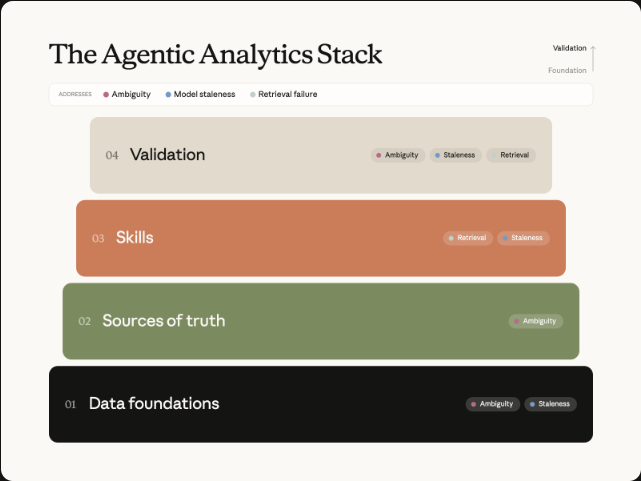
SOURCE: Anthropic published How Anthropic enables self-service data analytics with Claude. June 2026.
My Take: I agree that “data foundations” is the base layer.
Engaging with data via a Claude interface is intriguing, but typically 95% accurate is not good enough for most use cases.
And this will struggle when interrogating petabytes of data (right?).

Skeuomorphism.
What a cool word.
“Skeuomorphism: Designing a new thing to look and behave like the old thing it replaces, even when the imitation serves no functional purpose.”
How does this relate to AI?
Early movies were just like plays, but on a big screen. Early web pages were just like magazines, but online. The new medium arrived, and we made it look familiar.
Just like in the early days of the internet, no one had yet thought of social media. Entire jobs/companies/industries are going to change.
For me, AI is doing my research and rote processes much better. This is the same workflow I would have done 5+ years ago, just faster and better. This is not peak AI. I/m trying, but I am not there yet.
How does this relates to SymetryML?
Today’s standard model for data-driven alpha:
more data + more compute = better signal.
Those with deeper pockets to buy more data and run more rows win. The unit of work is an ever-expanding collection of billions of rows. AI might help you ask different questions, or process them faster. But it's still the same race.
SymetryML changes the unit of work entirely.
SymetryML changes from “re-scan the rows” to a “statistical twin” that never grows with new rows, just updates.
The compute constraint disappears. And when the constraint disappears, so do the old questions. You start asking questions that weren't previously possible.
Thanks for your thoughts on my article and for sharing it with this community. Would love a chat with practitioners who are facing the identtiy crisis as they build MDMs, CDPs, knowledge graphs and other data foundations.