Alternative Data Weekly #298
Theme: Memory Is the Moat

Special thanks to our sponsor SymetryML!

Increase Research Throughput Without Increasing Infrastructure or Compute Costs.
SymetryML helps funds interrogate massive real-time data to uncover usable signals faster, without the compute costs, pipelines, and data-engineering burden of conventional analytics.
We still have 3 open slots for a free pilot.
Get details and claim a slot: hello@symetryml.net.
QUOTES
“Bad data does not always scream,” he said. “Sometimes it arrives as a clean chart and a spectacular Sharpe ratio.” - Renato Guerrieri
News
Pods
Charts
Final Thoughts (Distribution)

#1 – Gurbinder Gill published An LLM Without Memory Is Just a Very Expensive Prompt. July 2026.
My Take: The winners in the AI age will be those firms that understand their own businesses well enough that they can build the workflows that compound over time (and workflows that deliver deterministic outputs when that is appropriate).
But … this requires persistent storage, and a consistent memory layer that is always on (suddenly losing context = arghh!). As this baseline gets bigger, and when talking about the very detailed workflows of complex orgs, this stuff quickly gets complex, expensive, and slows down the response times.
“Accumulated context becomes a key-person risk“ (source: Modern Data 101, Animesh Kumar)
Getting all the key-person context & knowledge (data, data, data!) into the system is the win.
#2 – A-Team Insights published How Much Hedge Fund Alpha Is Lost Before the Model Even Runs? June 2026.
My Take: This is a problem as old as data itself. Dealing with bad data, finding it, cleaning it, organizing, it … what a pain.
I thought this discussion around point-in-time to be particularly interesting. Everyone interprets that term differently. I found there was always a ton of confusion.
Of course, AI takes this all to a massive scale. Good processes early in the stack help tremendously.
BONUS: Meltem Demirors published The World as Model. June 2026. “The best representation is not necessarily the richest one. It’s the simplest representation that preserves the information required to accurately reconstruct or predict the system’s behavior.”
“Every representation is ultimately a decision about compression.” (my company SymetryML - & this week’s sponsor - solves this … no need to sample or compress … no trade-off decision required).
What else I am reading:
Dan Evans published Everyone’s Building Agents. Almost Nobody’s Built the Foundation. July 2026.
Olga Berezovsky published The Model Is Smart. Your Company Is the Problem - Issue 322. July 2026.
Abraham Thomas published On Data Quality. June 2026.
Jason Derise published Summer Inspiration 2026: Books, Podcasts, and Newsletters Shaping Data and Investing. July 2026. (thanks for the ADW mention!)
Nehhaa Purohit published Building Mature, Decision-Driven Data Organizations. June 2026.

Source: Tristan Handy talks with Claire Gouze, co-founder and CEO of nao Labs. The context engineering playbook. July 2026.
My Take: Interesting interview with a founder of nao Labs. It is pronounced “nao” … like “now” … not pronounced “n. a. o.” ...
Recent pivot from “Cursor for data strategy” ... to “context layer” (13:10 …talked about the pivot). Basically wanted to focus on things people are excited about. The idea of a context engineer has legs (18:20). They published a context engineering playbook.
Evaluation frameworks … intriguing to Tristan:
Methods ... not what to put into your context.
Be focused on first use cases.
Start small, set up scaffolding, eval framework running…
Machine vs human context (28:30).
Where does this go? Everything ends up in .md files & needs to be as close as possible to daily work. Then, whose job is it to edit .md files?
This is important because adding relevant context increases quality.
In my experience, the more context, the more narrow the use case. You wind up creating a bunch of agents … because each project (even if very similar) has slightly different context. This is where deep domain experience makes a massive difference. I think nao’s pitch is saying are the source of context truth for agents.
Tristan just returned from Snowflake summit … “context for agents was the most widely talked about things on the vendor showroom floor” (14:00 – Tristan comment).
HIGHLIGHTS (50-Minute Run Time)
Minute 01:20 – Claire’s background
Minute 04:00 – custom build vs using the available tools
Minute 06:00 – nao background
Minute 07:30 – how are coding agents going to impact consulting world?
Minute 20:00 – context engineering playbook
Minute 24:00 – Ramp example
Minute 25:45 – who does this work?
Minute 28:00 – machine vs human context
Minute 40:00 – plugging into production data + plugging into production context
Minute 45:00 – files system is all you need (or is it?)
Minute 48:00 – thoughts on open source
BONUS: Marc Andreessen on AI, California, and the Future of America | Joe Rogan. May 2026.
My Take: I listened to this entire 3-hour podcast while driving last weekend. I really enjoyed it. Specifically this part:
“Andreessen argues that AI should be understood less as replacement technology and more as a universal layer of cognitive augmentation, giving individuals access to capabilities that previously required teams of experts.”
This validated the experience I am having with AI. I am experiencing the same cool things and shortcomings Andreesen described. Assuming he is on the forefront of all things AI, this was very affirming for me.

SOURCE: Modern Data 101 published The Modern Data Report 2026: The Data Activation Gap. June 2026.
Research from 540+ data practitioners on the gap between data platform capabilities, operational reality, and business outcomes.



Distribution. This is what I am good at & what I enjoy doing.
Today’s Top Founders All Have One Thing in Common
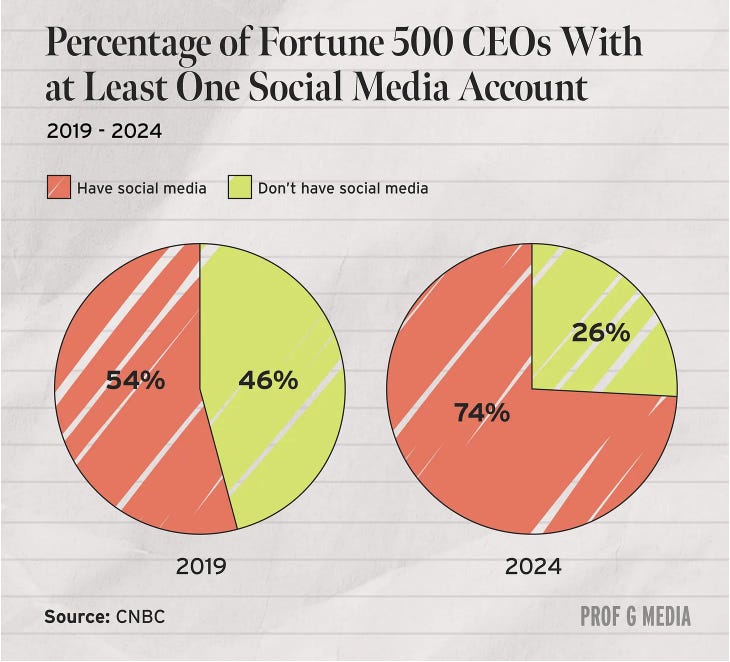
“Distribution Is the New Moat”
How to break through the noise? Even when proven founders are using a proven technology to solve real problems, it is tough to get the attention of the decision makers.
Getting the word out. Causing someone else to take action.
When Elon bought Twitter, I got the sense that he really didn’t want to, but was in too deep that he would have gotten sued if he pulled out late in the deal. This has proven to be a massive positive for him. He has 240M+ people who he can reach.
240M+ people!
Talk about getting the word out.
Then … telling a compelling story is powerful (and harder than one might think)!
Funny: