
Alternative Data Weekly #299
Theme: The Physical World Is Getting Its Tape

ADW is free, but I appreciate the support of those who are paying subscribers.
Special thanks to our sponsor SymetryML!

Increase Research Throughput Without Increasing Infrastructure or Compute Costs.
SymetryML helps funds interrogate massive real-time data to uncover usable signals faster, without the compute costs, pipelines, and data-engineering burden of conventional analytics.
We still have 3 open slots for a free pilot.
Get details and claim a slot: hello@symetryml.net.
QUOTES
“Any sustainable investment edge from alternative data tends to reside in people and processes.” - Vinit Agrawal & Jason Nogueira
News
Pods
Charts
Final Thoughts (second brain)

#1 – Kunal Mehta published We Don't Have a Data Problem. We Have a Signal Problem. July 2026.
My Take: The bottleneck is no longer data, or even access to data. It is attention and context. Can you sift petabytes of noise for the one piece that matters? Can you do it in real time? Can you do it at scale?
Kunal describes the goal as a “living picture of what is actually happening.” Building that “mosaic”, reading the situation, and handing the decision-maker only the piece they need is a genuinely hard problem. My former company ModuleQ spent years working on exactly this. I learned firsthand how hard it is to do, and how powerful it is when done well.
Two lessons from that experience still hold. The more context you give the system, the better it performs. The more you engage with it, the better it gets. The winners in this next phase will not be the ones holding the most data. They will be the ones feeding their systems the most context, with an engine on top that delivers only the right information, at just the right time.
#2 – Meltem Demirors published The World as Model. June 2026.
My Take: I was watching the MLB draft earlier this week when I heard a scout say that MLB prospects need to get to a place (NCAA school, HS team, baseball camp, etc.) that will start to collect their data. The right baseball data collection equipment will capture spin rates, swing speed, exit velo, etc. In this new world of baseball, these numbers will get you found by the scouts (or ignored).
Meltem argues that capital follows information density. Just like how an MLB scout might find you once you have a dense collection of real data about your baseball talents, there is value to be found in data that is collected. Yet, there are large parts of the world that have not yet been digitized. Industrials companies offered as a case in point. We should build for industrial companies what HFTs built for markets. Native resolution data collections that will demonstrate real value in short order.
#3 – Vinit Agrawal & Jason Nogueira published How alternative data drive investment insight and alpha potential. July 2026.
My Take: Investment analysts can dig deeper into the companies and industries they cover than ever before. AI tools are making engagement with all sorts of data more impactful, traditional and ‘alternative’ sources alike.
Implemented correctly (and this is not easy), teams can separate signal from noise to strengthen confidence in their investment theses.
What else I am reading:
Jody Hesch published Fundamentals of Engineering: Part 1 (Part 2: Here). July 2026.
Cindy Lin published MCPs Are Becoming Finance’s New Plumbing. July 2026.
Davis & Cole published How the Growing Use of Alternative Data Sources Is Reshaping How Professional Traders Identify Market Inefficiencies. July 2026.
Dan Entrup published Strategic Strategery. July 2026. Related announcement: AggKnowledge Launches Healthcare Data Product.
The Economist published Kevin Warsh’s new Fed. July 2026.

Source: Stan Altshuller interviewed Pouya Taaghol: How Alternative Data and AI Are Predicting Market Moves Before Everyone Else. July 2026.
My Take: Alternative data is not always found in private, hard to find places …sometimes it is just public data, organized really well. Different people will interpret the same data differently. Which keeps things interesting.
Pouya Taaghol founded Big Data Federation. He started by counting cars in parking lots. He highlights the benefit of hiring science guys vs finance guys to unlock value. He suggests that the US stock market digests information and predicts stuff. There is value to be found here.
“I want everyone to see what I am doing” (minute 14:45)
Alpha decay:
1- Panel data (panel can change) … can you make the panel stable?
2- Surveys (only includes the people who respond).
3- Factual data … (TSA data, Semiconductor Association, etc.).
HIGHLIGHTS (33-Minute Run Time)
Minute 01:00 – interview starts; Pouya’s background
Minute 06:00 – Science guys vs finance guys
Minute 09:00 – getting outside the noise and the benefit of independent thinking
Minute 12:00 – details on the BDF product
Minute 16:00 – same data but different conclusions
Minute 17:00 – UltraBlue Capital (fully automated long-biased fund that trades using BDF data)
Minute 22:00 – alpha decay
Minute 28:00 – Pouya’s journey

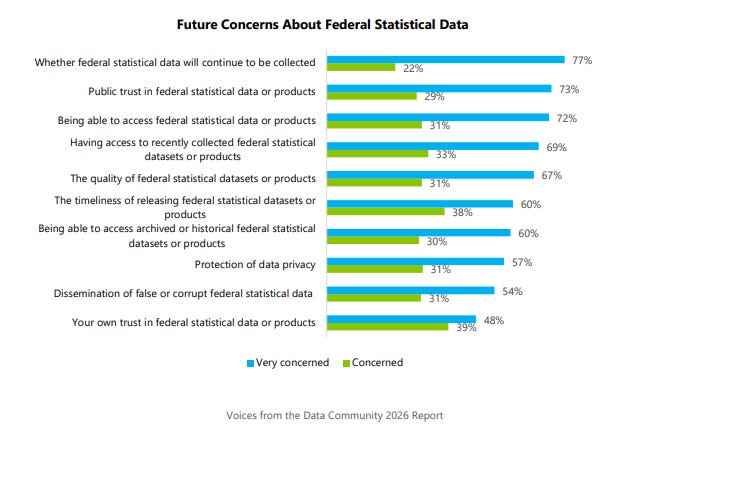
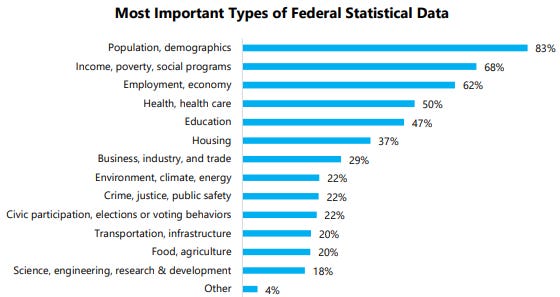
SOURCE: SSRS published Voices from the Data Community: How 2025 Has Impacted Public Data Users. May 2026.
“The federal statistical system is under stress — and public data users are feeling it.”
My Take: The recent interruptions of government data flows are an opportunity to improve how we work with data. This should cause users of gov’t data to want to broaden the data sources we use to determine how we are doing as a country (i.e. include more alternative sources of data).
Related article: The Economist published Kevin Warsh’s new Fed. July 2026.
“Kevin Warsh recently announced five new task forces to review the central bank’s communications, balance-sheet, inflation framework and use of alternative data…”
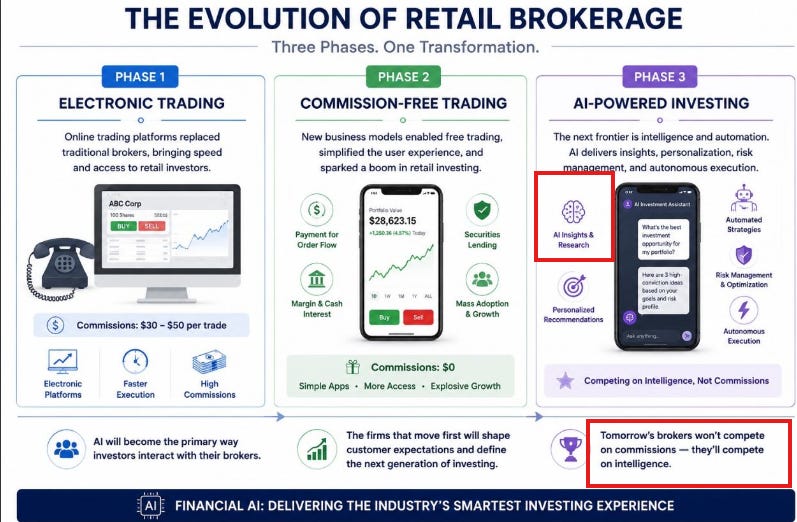
BONUS: Pouya Taaghol published The Evolution of Retail Brokerage. July 2026.
Phase 1: Electronic Trading – Online trading replaced traditional brokers, making investing faster and more accessible, though commissions remained high ($30–50 per trade).
Phase 2: Commission-Free Trading – New revenue models enabled free trading, simplified the user experience, and fueled a massive increase in retail investing.
Phase 3: AI-Powered Investing – As commission-free trading and modern apps become standard, the next competitive advantage is AI: delivering personalized insights, automation, and intelligent investment decisions.

Second Brain: I can only hope it is better than my first brain.
I have spent the past few months building a “second brain” ... an AI system that remembers what I read, who I talk to, and what I decide. The lesson: the more the system knows about me, the better it works. Context is the fuel. I can only imagine what happens once glasses record my everyday movements and the system starts learning how I actually operate (and starts helping me get better).
Which got me thinking more broadly about this idea.
MLB scouts will tell a young prospect to get to a place where they can start to build a corpus of data. Produce the right data (spin rate, exit velo, etc.) and they will find you.
Jim Simons was early in this game … from Zuckerman’s The Man Who Solved the Market (source):
“The real thing was to gather a tremendous amount of data — and we had to get it by hand in the early days. We went down to the Federal Reserve and copied interest rate histories and stuff like that, because it didn’t exist on computers.”
Now the same sequence is arriving for the physical world. Meltem Demirors argues in The World as Model (featured above) that machines, pipelines, power systems, and buildings generate continuous signals across hundreds of modalities, and most of them go uncaptured. The ones that are captured rarely arrive at a resolution where data becomes predictive instead of descriptive. Her example: a temperature sensor polled every fifteen minutes tells you a machine ran hot. A millisecond vibration signature tells you a bearing is failing three weeks before it does.
So here is the question for anyone running a company, and it is not “what data do we need?” Simons could not have answered that in the 1970’s, and you cannot answer it today. The question is: what signals is your business letting die unrecorded? The interest rate history nobody copies down, the vibration signature nobody captures, the customer interaction nobody logs ... none of it can be bought back later.
Missed data is the only truly unrecoverable asset.
Everything feeds the machine. The only thing it can never learn from is what you didn’t write down.