
Alternative Data Weekly #300
Theme: Building Is Fast. Data Is Everywhere. Value Moves to What Can't Be Copied

Special thanks to our sponsor Sidekick Lab!

Sidekick is the Agentic AI layer that gives your enterprise a living, governed understanding of your data estate.
We provide the ontology for your data to finally speak the same language as your business.
QUOTES
“Building is now so fast that it’s easy to produce things nobody asked for.” - Dylan Anderson
News
Pods
Charts
Final Thoughts (what will be valuable in the future?)

#1 – The Terminalist published Bloomberg’s Last Stand. July 2026.
My Take: I am assuming most ADW readers have already seen this piece as it was published just over a week ago. It is a must read when The Terminalist publishes anything. I set aside some time last weekend to read through this. There is a lot of insight here. I’ll focus on the idea of data FOMO.
“Once it exists, not consuming it can be a risk.”
I’ve attempted to articulate the idea that alpha used to come from access to data (buying the $30k BB license, knowing where to look) … now that, in theory, everyone has access to all the same data … the alpha is going to come from organizing the data, structuring the workflow, and asking the best questions. FOMO shifts from missing the right data to missing the right question.
From the sell side’s perspective, they will create value by creating unique proprietary data sets … (surveys, expert conversations, channel checks).
From the buy side’s perspective, they will create value by organizing workflows & data assets in such a way that their questions get the highest quality answers. Rather than creating your workflows around the data assets & tools like Bloomberg, the best buy-side firms will create the best workflows and fit the data assets into those workflows.
Now you just need to ask the right questions (that’s the hard part, right?).
#2 – Chad Sanderson published The Shift Left Manifesto - v2. July 2026.
My Take: This is an update to The Shift Left Manifesto - v1, published March ‘25.
“Shift left” means fixing and organizing your data earlier in the process, ideally, right where it’s created, instead of waiting to clean up the mess later.
The mantra of ship new stuff fast meant decentralization … which means no single team has the full picture. Which causes a lot of new problems, but new stuff is getting shipped quickly, so this is good, right? The answer in part is “shift left” so that the decentralize teams are working off the same ground truth.
As more people are engaging with AI tools that give everyone the ability to get answers, terms like evaluation, traceability, provenance suddenly become hot topics.
At the end of the day, some human needs to stand behind the answer with confidence. Moving closer to the source (ideally all the way to the code) will help.
BONUS: Vin Vashishta published The Context Moat Is Real, But Most Enterprises Don’t Have One Yet. July 2026. “…the moat is moving from the model to the proprietary knowledge that makes models and agents valuable.”
What else I am reading:
Extraordinarily sad news: Elizabeth Pritchard Obituary :Transformational Chief Data Officer. July 2026.
PwC & Eagle Alpha published Data monetization for CFOs: How to find, assess and execute opportunities. July 2026.
Simply Wall St. published Is TransUnion’s (TRU) Alternative Data Push Quietly Redefining Its Core Competitive Edge?. July 2026.
Rishabh Raj published Alternative Data May Soon Become Mainstream Investing Tool, Says S&P Global’s Aditya Sharma. July 2026.
Bruce Kappler published The Supreme Court Expands Privacy Rights to More Squarely Encompass Your Digital Footprint. July 2026.
Matt Robinson published AI Turns Plain English Into Backtests: Lord Abbett’s Tal Fishman. July 2026.
Ergest Xheblati published The Demand Perspective in Data. July 2026.
Book Alert: Roopika Risam published Data Empire: The Power of Information to Organize, Control, and Dominate. July 2026. Excerpt: 2126: The year data will be controlled by citizens, not tech companies.

SOURCE: Daniel Beach published an interview with Hugo Lu, Agentic Data Engineering Is Here — But Can It Close the Loop?. July 2026.
My Take: This was a bit technical for me, but interesting to hear some of the pain points these two describe and what they are doing about it (Lu’s Founding story of Orchestra).
The opportunity: how people build data pipelines is changing. You can make a big impact if you are ahead of the curve.
I like how Hugo talked about dealing with the massive change happening in the world. Bottom line: Stay focused. Simplify. Every enterprise has multiple data tools. These need to work together. This won’t change.
Last one … discussion of what happens when you are fully locked into a single model provider and they move to increase price? This is when, not if.
HIGHLIGHTS (33-Minute Run Time)
Minute 01:00 – Hugo Lu of Orchestra; background in data engineering.
Minute 07:00 – importance of testing; little things creep in.
Minute 09:30 – training junior developers.
Minute 12:00 – the background on Orchestra.
Minute 15:30 – Agentic Data Engineering.
Minute 20:00 – shift toward speed and simplicity.
Minute 25:00 – what’s next? Staying up with all the changes.
Minute 27:00 – focus on the good user experience for the basics … observability, monitoring, alerting, etc.
Minute 29:30 – dealing with token costs.

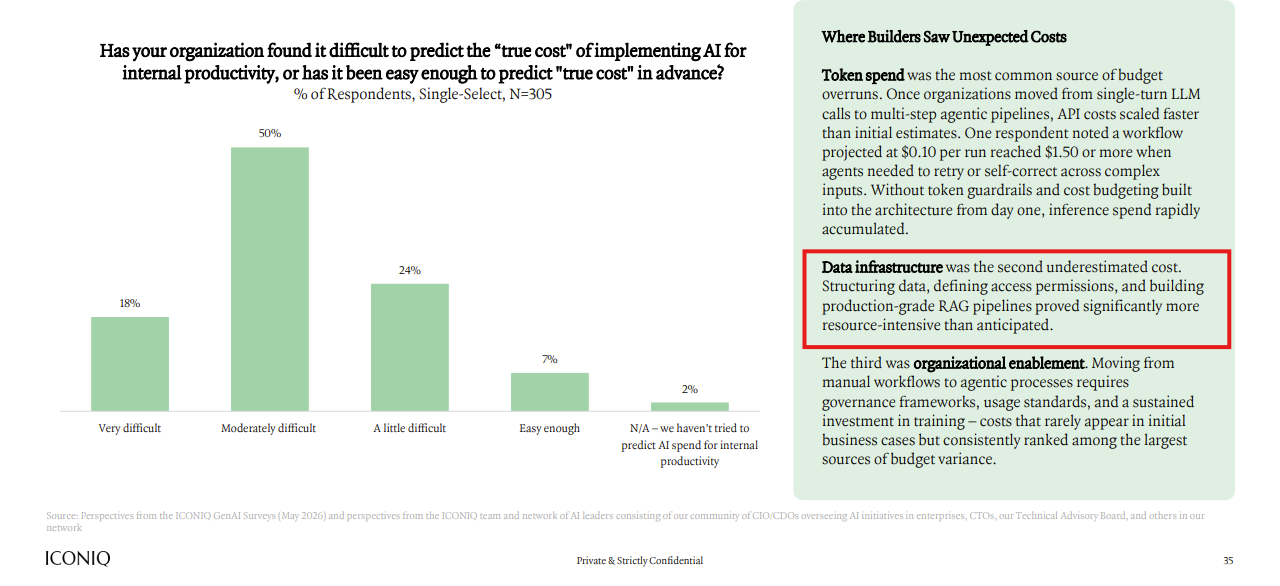
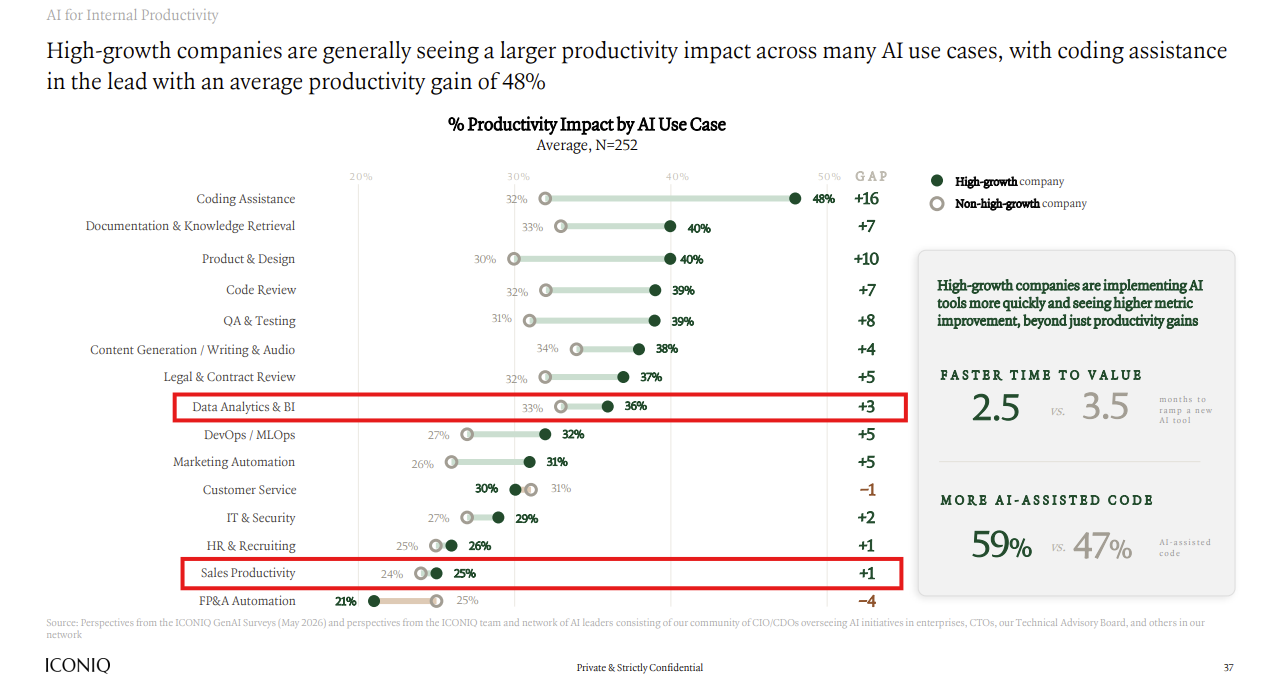
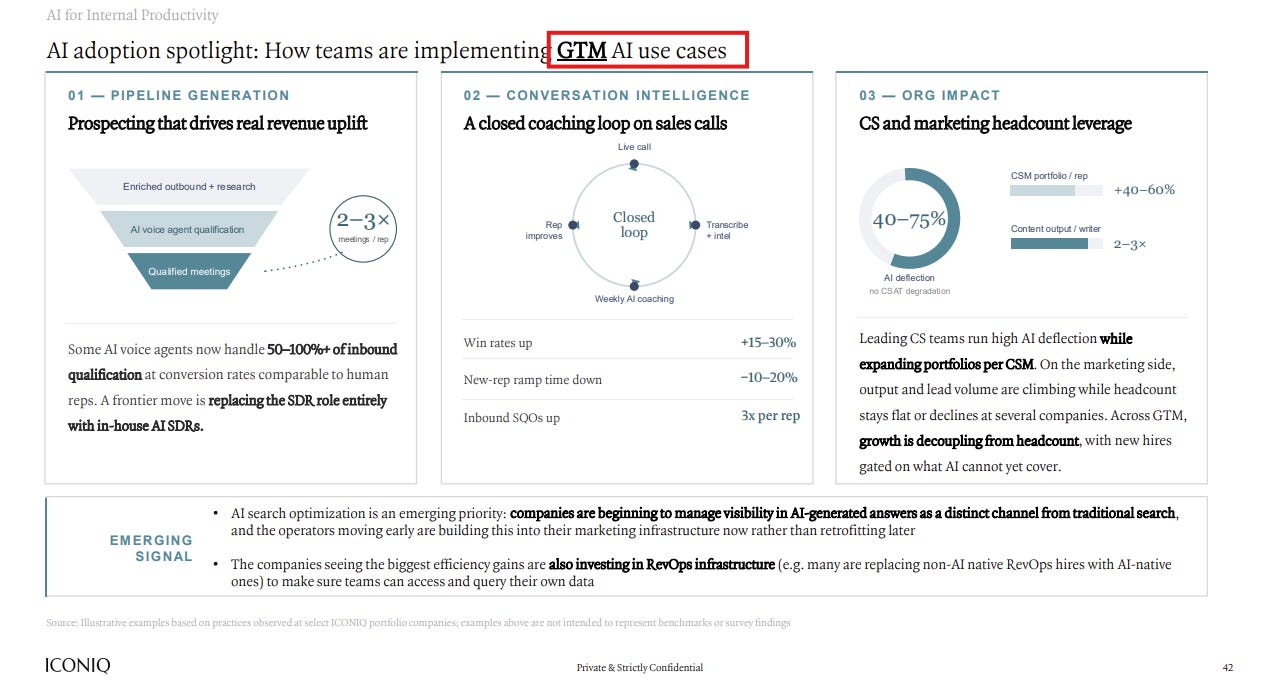
SOURCE: ICONIQ published 2026 State of AI Report: The Builder’s Economy. July 2026.
“This report is ICONIQ’s third bi-annual report of the AI builder landscape, grounded in our proprietary Q4 2025 and Q2 2026 surveys of executives at software companies building AI products, alongside perspectives from our ICONIQ Community. Across both waves, one shift stands out: the market has moved from proving AI works to proving AI pays.”

What will be valuable in the future?
Elon says everything will be free.
If intelligence is free and everyone has access to all the information, do we all end up like the people in Pluribus, or is there something others will desire? What will people find valuable? When everything is abundant, how do we stand out?
People will continue to chase status.
If you can deliver something that will help them increase their perceived status, they will pay you. The most obvious is that if you can help them make more money (more money = more status) … then you will get paid.
Kevin Kelly put together an interesting piece on the idea of value when as things get cheaper (interesting: this was originally published in 2008 … he updated for 2026 and not much changed).
His words (my words)
1. Immediacy — (now where was that thing?)
2. Personalization — (I value the effort someone put in to make this just for me)
3. Interpretation — (what does all this mean? Why should I trust you?)
4. Authenticity — (community)
5. Accessibility — (I don’t want 50 user names & passwords)
6. Embodiment — (live events)
7. Patronage — (support creators — ADW)
8. Findability — (the right info at the right time)
“…these new eight generatives demand an understanding of how abundance breeds a sharing mindset, how generosity is a business model, how vital it has become to cultivate and nurture qualities that can’t be replicated with a click of the mouse. These generatives are very human skills, by the way, which AIs are not very good at – yet.”